


The New York Times: As Regional Theaters Struggle, Some Defy the Odds
As Regional Theaters Struggle, Some Defy the Odds
Naples, Fla., and Milwaukee are quite different, but have one thing in common: They are home to regional theaters that are thriving.
Reporting from Milwaukee and Naples, Fla.
Originally published in The New York Times
Dec. 15, 2025
America’s regional theaters are facing difficult times: staging fewer shows, employing fewer workers, and running deficits more frequently than before the pandemic.
But not all of them are struggling. Some are booming.
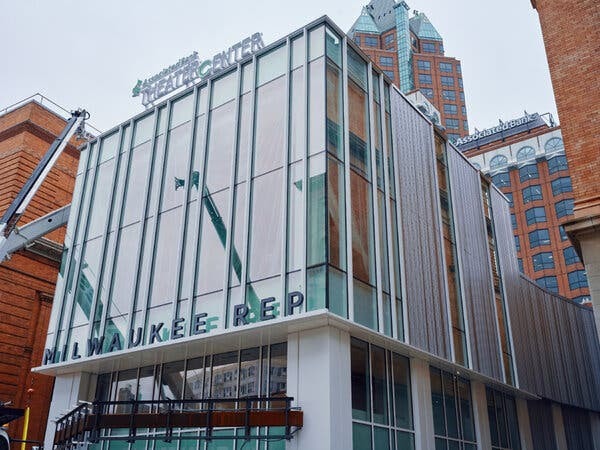
In Wisconsin, Milwaukee Repertory Theater has finished the first phase of an $80 million renovation of its three-theater complex in an old power plant along the Milwaukee River. In Naples, Fla., Gulfshore Playhouse has just begun its second season in a new $80 million complex with a curved facade meant to evoke the nearby sand and sea.
Both theaters are now breaking their own records. Milwaukee Rep’s staging of “Come From Away,” the first show on the theater’s renovated main stage, has just ended its run as the highest-grossing production in the company’s 71-year history. And Gulfshore Playhouse’s current production, “Irving Berlin’s White Christmas,” is breaking every record for that company, with a nightly waiting list for people seeking seats.
Kristen Coury, the Playhouse’s chief executive and producing artistic director, described her programming mantra as “up and known.” Translation: When deciding which shows to produce, she selects ones that are upbeat and well-known.
“We’re at a moment now where there’s a lot of poke-you-in-the-eye theater, like, ‘I don’t care what you think — this is good for you, and I’m going to make you feel like a terrible person, and you better buy a ticket anyway,’” Coury said.
“My first covenant is with the audience, and I care about what they think,” she added. “People don’t want to spend money on a show they don’t think they’re going to like.”
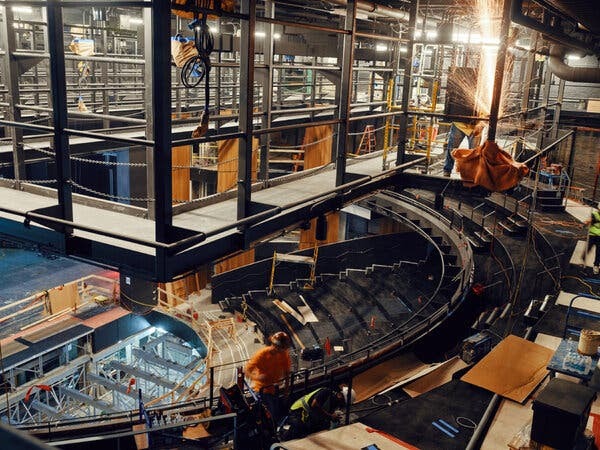
Milwaukee Repertory Theater has finished the first phase of an $80 million renovation, with a 670-seat main stage. Credit…Caleb Alvarado for The New York Times
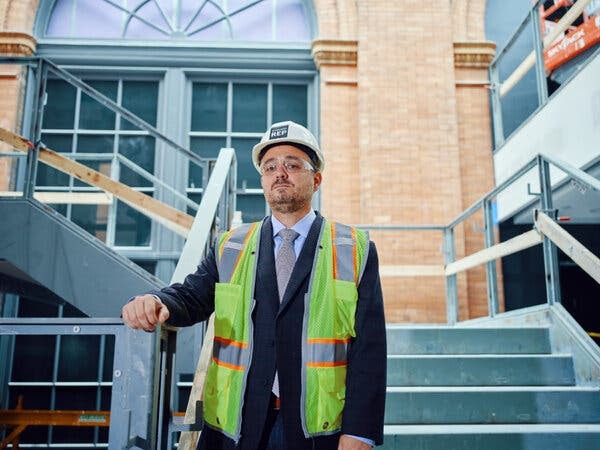
“We were doing performances when almost nobody else in the entire country was doing them,” said Chad Bauman, the executive director of the Milwaukee theater. Credit…Caleb Alvarado
The Milwaukee theater’s leaders, though making different choices in all sorts of ways, make a similar point. “We actually like our people,” said Mark Clements, the artistic director in Milwaukee. “We’re not trying to be didactic and lecture people.”
For a struggling industry, these two theaters — and a handful of others — are models of success: They are producing a healthy menu of shows, drawing large audiences, running budget surpluses and raising money for capital projects. But they are definitely in the minority.
American theaters, after some initial signs of recovery postpandemic, have more recently taken a second dip, according to Jen Benoit-Bryan, the executive director of SMU DataArts, a national arts and culture research center at Southern Methodist University.
The numbers are grim — from 2023 to 2024, theater attendance fell 19 percent and income fell 37 percent, according to SMU DataArts. “Everybody is hurting, but theaters are hurting at a different scale than other arts organizations,” she said.
Figuring out what thriving theaters have in common is complicated. They vary in location, size and degree of influence, and include companies like Pasadena Playhouse in California and the Guthrie Theater in Minnesota.
A number of them (but not all) seem to share a few distinctive attributes: communities with less-competitive cultural landscapes, where the theaters have high visibility and civic standing; programming philosophies that prioritize what audiences might want to see over what artists believe audiences would benefit from seeing; and the lingering benefits of having minimized the duration of their Covid shutdowns, which helped audiences maintain the theatergoing habit.
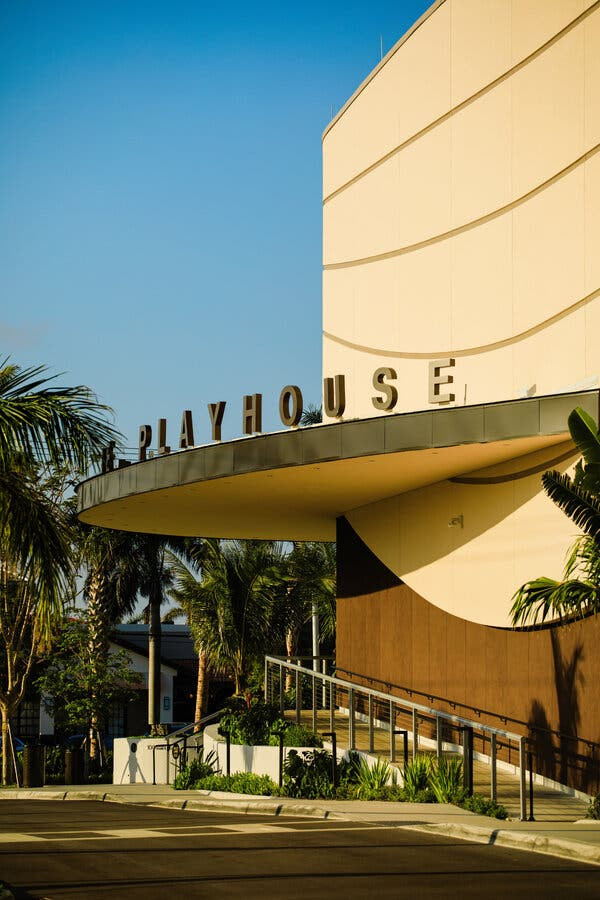
Gulfshore Playhouse produces seven shows a season. Since the pandemic, the theater’s annual budget has risen to $14.5 million from $3.6 million.Credit…Scott McIntyre for The New York Times

Kristen Coury, the Playhouse’s founder and artistic director, at the final performance of last season’s “Sweet Charity” with the show’s lead actress, Kate Marilley.Credit…Scott McIntyre for The New York Times
At the start of the pandemic, Gulfshore laid off three-quarters of its staff, opting to safeguard its resources for reopening. “While we were doing that, other theaters were spending a truckload of money keeping people employed for a year who were doing nothing but sewing masks,” Coury said.
Milwaukee Rep, on the other hand, retained 95 percent of its staff, believing it would allow them to restart more quickly. The theater was worried about a talent drain, which many of its peer institutions experienced during the pandemic; it also arrived at the pandemic with sizable cash reserves, giving it options.
“We took a very different path than the rest of the field,” said Chad Bauman, the theater’s executive director. “We were doing performances when almost nobody else in the entire country was doing them.”
Milwaukee Rep, founded in 1954, is one of the nation’s oldest professional regional theaters. Gulfshore Playhouse, founded in 2004, is one of the newest — it was just admitted to the League of Resident Theaters, a national association of 81 leading regional theaters, in 2022. Both theaters have big dreams — they hope to attract pre-Broadway productions, which bring revenue and attention to regional theaters, but are hard to book, because expectations of audience, staff and facilities are high.
The two communities are quite different. Milwaukee is a sizable, historically blue-collar, overwhelmingly Democratic city, while Naples is small, packed with affluent retirees, and heavily Republican.
A commonality: The two areas have a lot of captains of industry. “We have the highest per capita amount of former C.E.O.s,” Coury said of Naples. She added that 90 percent of her fund-raising is from individuals, rather than corporations or foundations, and the biggest donors are Jay and Patty Baker, who gave $20 million. (He is the former president of Kohl’s.)
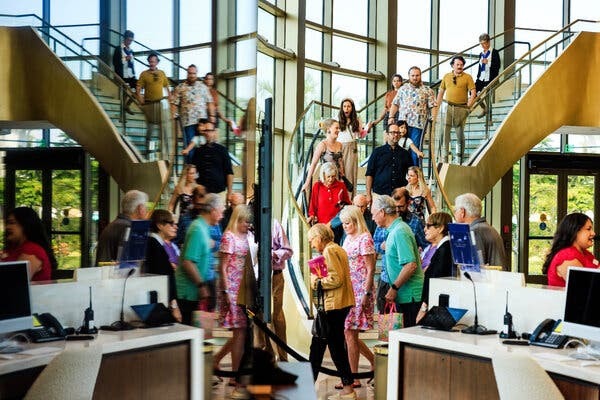
“My first question is always, ‘Is it good?’” Coury said of her approach to programming. “Not, ‘Do you feel like it will teach a good lesson?’ and not ‘Which agenda is attached to it?’ Just ‘Is it a good play?’”Credit…Scott McIntyre for The New York Times
Milwaukee still has a robust corporate community, and the Rep has done better than many of its peers at attracting corporate contributions — the biggest donor to its renovation project is the largest Wisconsin-based bank, Associated Bank, which gave $10 million, and for which the theater center is now named. (By coincidence, the Bakers previously lived in Milwaukee and supported Milwaukee Rep.)
Both theaters’ capital projects faced significant damage from big storms. In Naples, Hurricane Ian knocked down several walls of the new Gulfshore Playhouse while it was under construction in 2022; in Milwaukee, intense flooding in August caused $7 million in damage to a production facility where the theater had been storing sets and costumes (including for its mainstay production of “A Christmas Carol”) while building its new home.
Gulfshore, which produces seven shows a season, has been growing fast; since the pandemic its annual budget has risen to $14.5 million from $3.6 million, and it now has 83 full-time employees. Its new main stage theater is nearly twice the size of the one in its former home — 368 seats now, compared to 200.

In Naples, Fla., the theater’s new building also has a 125-seat black box theater. Last year it produced three plays with sobering themes, including “The Lehman Trilogy.”Credit…Scott McIntyre for The New York Times

“Sweet Charity” closed Gulfshore Playhouse’s first season in its new home.Credit…Scott McIntyre for The New York Times
The theater opened its first season in its new home with “Anything Goes” and closed with “Sweet Charity.” It’s debatable if “Sweet Charity” is actually upbeat, because it ends unhappily for the protagonist, but both shows are indisputably classics, with songs that have become standards and big dance numbers. In between, Coury programmed two crowd-pleasing plays, the suspense drama “Dial M for Murder” and the farce “Noises Off.”
At the same time, in the new building’s 125-seat black box theater, Gulfshore staged three plays with sobering themes but a track record of success: “Every Brilliant Thing,” which deals with depression and suicide (and will have a Broadway production this season); “The Lehman Trilogy,” about the rise and fall of a financial empire; and “Lady Day at Emerson’s Bar and Grill,” about Billie Holiday as she is grappling with addiction.
“My first question is always, ‘Is it good?’” Coury said. “Not, ‘Do you feel like it will teach a good lesson?’ and not ‘Which agenda is attached to it?’ Just ‘Is it a good play?’”
Milwaukee Rep, with a $17 million annual budget and 125 employees, is a larger and more established company. It is producing 12 shows this season, including “The Lehman Trilogy” and “The Piano Lesson” (a Pulitzer Prize winner by August Wilson) as well as two Agatha Christie-related shows, and expects to do 13 next year. It also does lots of new work, and, unlike many of its peers, has a 14,000-person subscriber base that has remained remarkably loyal.
Chad Bauman, the executive director of Milwaukee Rep, said the theater’s secret sauce is its mission to entertain, provoke and inspire.Credit…Caleb Alvarado
“Obviously, theaters are struggling, and Milwaukee has bucked that trend,” said Ayad Akhtar, a Pulitzer-winning playwright (for “Disgraced”) who grew up in a Milwaukee suburb and serves on the Rep’s board. “There’s multigenerational industrial family support, and programming an artistic experience that is worthy of being thought about and at the same time can sell a lot of tickets.”
Akhtar’s “McNeal,” a play about artificial intelligence that debuted on Broadway last season, will reopen the Rep’s black box theater, with up to 220 seats, early next year.
The redone theater complex features some distinctive amenities — the main stage, with up to 670 seats, has different tiers, and the nicest seats (proving quite popular) are leather, with cup-holders and premium pricing. And the theater’s leadership can wine and dine donors in a backstage V.I.P. suite, with a window overlooking preshow warm-ups.
The theater’s leadership is proud of its status as an outlier, noting that not only is it defying downward trends on attendance and giving, but that it is also thriving in a state that has among the lowest levels of public arts funding in the nation.
The theater puts its three goals — to entertain, provoke and inspire — on banners.
“Where some have gotten into trouble is that they’ve over-rotated in one of these directions,” said Bauman, the executive director. “The secret sauce to programming is that if you’re an audience member, we have a really great, diverse mix of programming, and we never over-rotate in any one of those sides.”
Make a Donation Today
You play a vital role. By supporting Gulfshore Playhouse, you are transforming a region and transforming lives.